 Akston Health
Akston Health
Akston Health
Vitamin premix is small in volume, yet it carries a large nutritional responsibility. NASEM’s 2021 Nutrient Requirements of Dairy Cattle shows that cattle need carefully balanced vitamins and minerals for immunity, reproduction, growth, and feed efficiency. Uneven distribution can leave one animal over-supplied while another receives too little. The risk becomes greater in home-made rations, where hand mixing, coarse particles, and inaccurate scales often work against consistency.
This is why producers should learn how to mix vitamin premix evenly into home-made cattle feed. A practical method begins with a small carrier batch, such as bran or ground maize. Blend the premix into this carrier before adding it to the larger feed mixture. Use a clean, dry mixer, measure ingredients by weight, and maintain a fixed mixing time. Feed quality programs commonly treat a coefficient of variation below 10% as a useful uniformity target, although farm conditions may require stricter control. The FAO also stresses accurate formulation, clean handling, and traceability in responsible feed management.
Dairy nutrition specialist Dr. Jud Heinrichs has emphasized, “The goal of mixing is to provide every animal with the same diet.” That principle sounds simple. It is not always achieved. A dusty premix may settle beneath heavier grain, while damp feed may form small nutrient-rich clumps. NASEM data support precision, but real farms still face uneven equipment, rushed labor, and variable ingredients. Therefore, checking mixer performance, recording batch weights, and occasionally submitting feed samples for laboratory analysis can expose hidden mistakes. Good mixing is not perfection. It is repeatable control, followed by honest review.
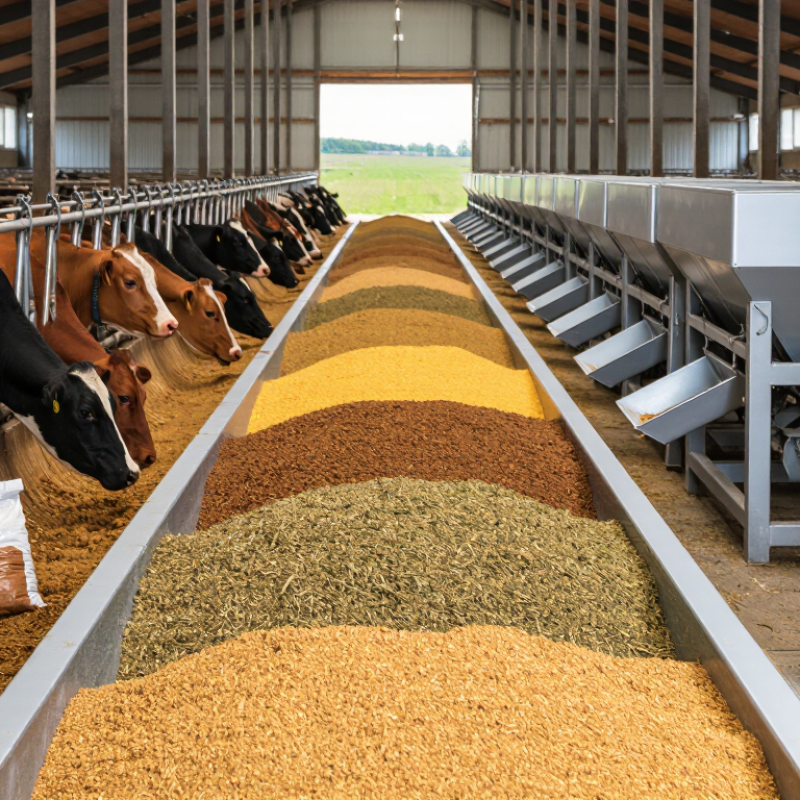
Why Evenly Mix Vitamin Premix Into Cattle Feed?
Vitamin premixes contain micronutrients at remarkably small concentrations. One part per million equals only one milligram per kilogram of feed. A 500-gram premix addition in 1,000 kilograms of feed equals 500 ppm. That sounds measurable. It is still difficult to distribute evenly.
The National Research Council’s Nutrient Requirements of Dairy Cattle, 7th revised edition, lists vitamin A guidance around 3,200 IU per kilogram of dry matter for lactating cattle. The actual inclusion rate depends on forage quality, animal stage, and farm conditions. A premix may carry several vitamins together, but each nutrient can have a different target. Small weighing errors can therefore affect the final ration.
Uniform mixing protects both deficiency prevention and cost control. Feed quality programs often investigate a mixer coefficient of variation near 10% or lower, although the suitable limit depends on equipment and local procedures. The FAO and IFIF Manual of Good Practices for the Feed Industry recommends controlled weighing, correct mixing order, and documented checks. In practice, dusty ingredients may separate during transfer, and overloaded mixers may create uneven pockets. This is where theory becomes less tidy. Sampling several locations, checking scales, and reviewing mixer time can reveal problems that a single sample misses. Even experienced operators sometimes trust the mixer too quickly.
| Micronutrient | Common Function in Cattle | Illustrative Complete-Feed Level | Approximate Amount per kg of Feed | Why Uniform Mixing Matters |
|---|---|---|---|---|
| Vitamin A | Supports vision, epithelial tissues, immune function, reproduction, and growth. | About 1,000–4,000 IU/kg | Usually supplied in IU rather than ppm | Uneven distribution can create low-intake pockets and excessive-intake pockets within the same batch. |
| Vitamin D3 | Helps regulate calcium and phosphorus metabolism and supports bone development. | About 200–1,000 IU/kg | Usually supplied in IU rather than ppm | Because the inclusion rate is small, poor dispersion may cause inconsistent mineral utilization among animals. |
| Vitamin E | Acts as an antioxidant and contributes to immune response and muscle-cell protection. | About 10–50 IU/kg | Commonly expressed in IU; product potency varies | Consistent mixing helps each animal receive a similar antioxidant supply across the ration. |
| Vitamin K | Participates in normal blood-clotting processes and bone metabolism. | Often supplied only when needed | Frequently measured in mg/kg when supplemented | Small dosage differences can be significant when the ingredient is concentrated in a premix. |
| Niacin (Vitamin B3) | Supports energy metabolism; supplementation may be considered in specific production or heat-stress situations. | Commonly 6–12 g/head/day when used | Dose depends on intake, animal class, and feeding program | Uniform distribution reduces the risk that some animals receive little or none of the intended supplement. |
| Riboflavin (Vitamin B2) | Contributes to cellular energy production and nutrient metabolism. | Usually supplied according to ration formulation | Often present at low mg/kg levels when supplemented | Low-inclusion ingredients are difficult to distribute evenly without premixing or controlled addition. |
| Thiamine (Vitamin B1) | Supports carbohydrate metabolism and normal nervous-system function. | Often supplied in specialized feeding programs | Typically measured in mg/kg when added | Even distribution is essential when the target concentration is only a few parts per million. |
One part per million equals one milligram per kilogram of feed. A 500-gram premix addition in 1,000 kilograms equals 500 ppm. Small numbers still create large mixing challenges.
Uneven mixing may give one animal too little and another too much. Deficiency can affect growth, fertility, immunity, and feed efficiency. Excess intake may disturb metabolism.
Yes. Fine particles may collect near mixer corners, conveyors, or discharge points. A quick visual check can mislead us. Look closer.
Particle size, density, moisture, carrier quality, loading order, and mixing time all matter. Heavy particles may move first during discharge. Lighter particles can remain behind.
Keep the premix dry and sealed before use. Calibrate scales regularly and add the premix gradually. Follow a validated loading and mixing procedure. Habit alone is not enough.
Collect samples from several mixer and discharge locations. Laboratory testing gives stronger evidence than one visual inspection. Record each batch, including batches that appear normal.
No. A variation near 10% or lower is often used as a practical target. It is not magical. Poor sampling can hide uneven distribution or create false concern.
Not always. Excessive mixing may increase separation after the mixer stops. Equipment condition, loading order, and discharge speed also matter. We may trust mixing time too quickly. That deserves review.
Evenly blending a vitamin premix into cattle feed is essential because these micronutrients are often added at parts-per-million levels. If the premix is not distributed uniformly, some animals may receive too little and develop deficiencies, while others may consume excessive amounts, increasing the risk of toxicity. Understanding how to mix vitamin premix evenly into home-made cattle feed helps support consistent nutrition across the herd.
Uniformity depends on matching particle size and density, selecting a suitable carrier, and adding ingredients in a practical sequence. A small premix quantity can first be blended with a larger amount of feed before being incorporated into the full batch. Adequate mixing time is important, but excessive mixing may cause separation. The goal should be a coefficient of variation below 10%. Representative samples from different areas of each batch should be tested to confirm even distribution and maintain reliable feed quality.
