Akston Health Akston Health

7 Tips How Do Probiotics Survive Pet Food Extruder Heat?

Time:2026-10-10 Author:Sienna
0%

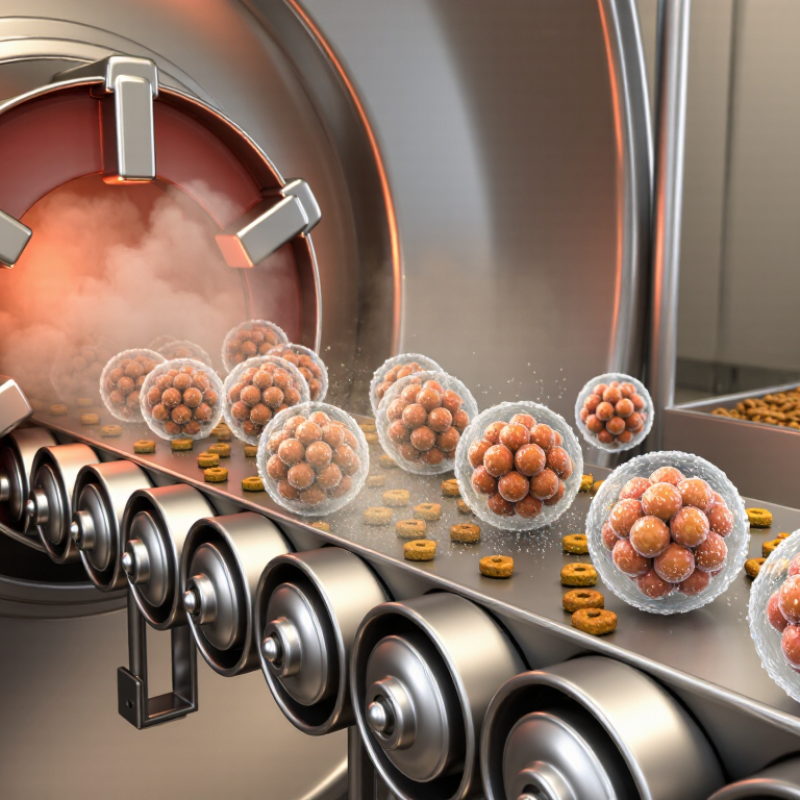
Extrusion creates a difficult journey for probiotic cells. Inside the barrel, temperatures can rise above 80°C, while pressure, shear, moisture, and oxygen increase stress. So, how do probiotics survive the high heat of pet food extruders? The answer involves several connected decisions, not one miracle ingredient.

Dr. Mary Ellen Sanders, an internationally recognized probiotic scientist, states, “A probiotic is a live microorganism that, when administered in adequate amounts, confers a health benefit on the host.” This definition matters. Survival alone is not enough. The strain must remain viable, stable, and useful when the pet consumes the finished food.

Manufacturers may select heat-tolerant strains, reduce unnecessary residence time, and protect cells with microencapsulation. Some products add probiotics after extrusion through vacuum coating or surface application. Protective carriers, controlled moisture, and careful cooling can also help. Picture the process clearly: a fragile cell enters a hot barrel, faces pressure, then lands in a cooling kibble stream.

However, laboratory survival does not always match factory performance. That is an uncomfortable detail. A strain may survive one formula but fail in another. Storage humidity, fat levels, oxygen exposure, and packaging can change the result. Reliable development therefore requires strain-specific testing before processing, after extrusion, and throughout shelf life. This guide examines seven practical strategies for improving probiotic survival while recognizing an important limitation: no formulation can guarantee perfect recovery in every production environment.
7 Tips How Do Probiotics Survive Pet Food Extruder Heat?

Probiotic Heat Resistance During Pet Food Extrusion

Probiotic Heat Resistance During Pet Food Extrusion

Probiotics face intense heat, moisture, pressure, and mechanical shear inside an extruder. Published extrusion studies commonly report barrel temperatures between 80°C and 150°C. Survival depends on the strain, water activity, residence time, and cooling speed. One universal protection method does not exist. That matters.

Seven practical controls can improve survival:

select heat-tolerant strains, test each strain separately, reduce unnecessary residence time, control feed moisture, use protective carriers, cool kibble quickly, and apply probiotics after extrusion when possible.

The International Scientific Association for Probiotics and Prebiotics states that probiotic benefits are strain-specific. Therefore, a generic “probiotic” claim offers limited technical information.

Independent testing should measure viable colony-forming units before extrusion, after extrusion, and at the end of shelf life. FAO and WHO guidance emphasizes maintaining viability until consumption, rather than testing only fresh production batches. A 2023 review in Animals also highlights the damaging effects of heat, oxygen, and storage humidity on probiotic stability. Packaging is part of the formulation.

A practical detail is often missed. A cool-looking kibble can still contain a large viability loss. Some studies report reductions of one to three log units after processing and storage, depending on the organism and matrix. Results vary. They should.

One assumption deserves challenge: adding more cells may not repair poor thermal design. End-of-shelf-life evidence remains the stronger measure.

Strain Selection for Survival in High-Temperature Processing

How Do Probiotics Survive Pet Food Extruder Heat?

Strain selection is the strongest defense against extrusion heat. Not every probiotic responds the same way. Some strains lose viability quickly at 80°C, while others tolerate short thermal exposure better. Spore-forming strains often show stronger resistance, but they may not provide the same benefits as non-spore-forming cultures. The right choice depends on survival, safety, stability, and the intended pet application.

Laboratory screening should copy real processing conditions. Test each strain at different temperatures, moisture levels, residence times, and oxygen exposures. A culture may survive a dry heat test but fail inside a moist kibble matrix. Measure viable cells before extrusion and after cooling. Then check stability during storage. Numbers matter. One test is not enough. We sometimes overvalue initial counts and overlook losses during shipping or storage.

Tips: Select strains with documented thermal tolerance. Use a meaningful safety history and verified identification. Test blends carefully, because one strain may weaken another. Add protective carriers when suitable, but confirm they do not affect texture or palatability. If possible, apply probiotics after extrusion through a controlled coating process. This reduces heat exposure, although coating uniformity can become a new challenge. Keep reviewing the data. Real production is rarely as gentle as a laboratory trial.

7 Tips: How Do Probiotics Survive Pet Food Extruder Heat? — Strain Selection for Survival in High-Temperature Processing

No. Processing Challenge Strain-Selection or Formulation Strategy Practical Processing Guidance Recommended Quality Target Verification Method
1 Extruder heat can rapidly reduce the viability of vegetative probiotic cells. Select documented heat-tolerant strains. Spore-forming bacteria generally provide greater thermal protection than non-spore-forming lactic acid bacteria. Screen candidate strains in the actual pet-food matrix rather than relying only on broth or laboratory-medium results. Strain-specific survival data after exposure to the intended extrusion temperature and residence time. Measure viable counts before and after processing using validated, strain-appropriate microbiological methods.
2 High barrel temperature, pressure, shear, and moisture act together during extrusion. Evaluate strains under a combination of heat, moisture, and mechanical stress. A strain that survives dry heat may perform differently in a moist extruder environment. Use pilot trials covering the intended barrel-temperature range, commonly about 70–120 °C, and the actual feed-moisture profile. Use a processing window that maintains acceptable product quality while minimizing unnecessary thermal exposure. Record barrel temperature, die temperature, feed moisture, pressure, screw speed, and residence time for every trial.
3 Long residence time increases cumulative thermal injury. Prefer strains with strong survival during short-time, high-temperature exposure and confirm performance at the fastest and slowest expected residence times. Keep residence time as short as product quality permits; many extrusion systems expose the product for seconds to approximately one minute, depending on design and operating conditions. Set a minimum post-extrusion viable count rather than assuming a fixed survival percentage. Compare viable counts at multiple residence times and report the change as log10 CFU/g.
4 Oxygen, friction, and drying can damage sensitive cells during and after extrusion. Use protective carriers or encapsulation systems compatible with pet-food ingredients, such as suitable carbohydrate, protein, or lipid-based protective matrices. Add the probiotic through the least damaging route available. Post-extrusion application is usually less thermally demanding than in-barrel addition. Choose a carrier that does not compromise kibble texture, palatability, water activity, or coating adhesion. Compare unprotected and protected preparations under identical extrusion and storage conditions.
5 Heat survival alone does not guarantee stability during shelf life. Select strains that retain viability under the final product's water activity, oxygen exposure, fat content, and storage temperature. Finished dry pet foods commonly have low water activity; maintaining the product below approximately 0.60 aw helps restrict microbial growth, but does not eliminate probiotic loss. Define a shelf-life viable-count specification at the end of the intended storage period. Test viable counts at release and during real-time storage, including normal and elevated-temperature conditions.
6 Post-extrusion coating can expose probiotics to oil, oxygen, and uneven distribution. Use a physically stable preparation that disperses uniformly in the coating system and remains compatible with fats and other surface ingredients. Apply probiotics after cooling whenever feasible. Control coating temperature, mixing time, surface coverage, and packaging exposure. Target uniformity between portions and minimize localized high-moisture or high-oxygen zones. Sample from the beginning, middle, and end of the coating operation and compare viable counts and moisture values.
7 Actual probiotic delivery may fall below the intended dose after processing and storage. Set the initial addition level using measured process loss and shelf-life decline. Do not apply a universal overage because survival differs by strain and matrix. Use pilot-scale data to establish the required starting concentration, then confirm it in commercial-scale production. Report the guaranteed viable count at the end of shelf life, typically in CFU/g or CFU per serving. Use batch-release testing, periodic shelf-life testing, and a documented sampling plan based on validated enumeration methods.

Technical note: Thermal survival is strain-, matrix-, moisture-, equipment-, and process-dependent. The temperature ranges and quality targets shown above are practical development guidelines; final specifications should be established using pilot and commercial-scale validation in the finished pet-food product.

Protective Ingredients That Shield Probiotics from Heat Damage

Probiotics entering a pet food extruder face more than temperature. Steam, pressure, shear, and moisture can weaken cell membranes. Protective ingredients help, but they cannot rescue every strain. This is where formulation discipline matters. A spore-forming culture may tolerate processing better than a delicate lactic acid bacterium. Results can vary.

Soluble fibers and prebiotic carbohydrates can form a protective matrix around probiotic cells. Protein sources, such as hydrolyzed plant proteins, may provide physical shielding during short heat exposure. Trehalose and selected sugars can stabilize cell membranes during drying. However, excessive sugar may affect water activity. Microencapsulation with food-grade lipid or polysaccharide coatings adds another barrier against heat and oxygen. The coating must release cells in the digestive tract. Too strong a barrier becomes counterproductive.

In production, a development team should compare probiotic counts before extrusion and after storage. An ingredient list cannot prove survival. Water activity, die temperature, residence time, and cooling speed should be recorded during every trial. A cooler post-extrusion coating step may preserve more viable cells than forcing probiotics through the barrel. Still, laboratory survival does not always predict shelf-life performance. Not always. That gap deserves honest testing with validated counting methods.

Extrusion Settings That Help Preserve Probiotic Viability

Probiotic survival starts with controlling the product temperature, not only the barrel setting. A lower setpoint may still produce excessive heat near the die. Measure the melt temperature directly when possible. Small differences matter.

Use moderate screw speed to limit shear and shorten residence time. However, excessive speed can raise frictional heat. Feed moisture also deserves attention. Higher moisture often improves heat transfer and reduces local hot spots, but it may increase drying demands later. Keep the process stable. Sudden changes in feed rate can damage viability.

Choose the lowest practical extrusion temperature that achieves proper starch cooking and pellet structure. The ideal range depends on the formula, moisture level, and probiotic strain. Some strains tolerate processing better than others. Avoid assuming one setting fits every product. This is where our assumptions can fail.

Rapid cooling after the die helps reduce continued thermal exposure. Post-extrusion application may offer better survival when the formula allows it. Protective carriers can also reduce stress during mixing and storage. Validate every adjustment by testing viable counts before extrusion, after cooling, and during shelf-life storage. Check water activity as well. A good count immediately after production does not guarantee stability later. In practice, the best setting is often a compromise between product texture, throughput, and measurable probiotic viability.

Post-Processing Application and Storage of Live Probiotics

Post-processing application protects probiotic cells after extrusion heat. The kibble should cool before coating begins. Many manufacturers target a product temperature below 40°C, but the correct limit depends on the strain and carrier. A calibrated infrared thermometer helps confirm the surface temperature. Live cultures can be sprayed with oil, broth, or a dry protective blend. Uniform coverage matters. Uneven coating may leave some pieces rich in cells and others nearly empty.

Application equipment needs gentle handling. Excessive pressure, long mixing cycles, and wet surfaces can reduce viability. Technicians should measure viable counts after coating and during shelf-life studies. These tests show whether the intended dose remains available when pets eat the food. One test is not enough. Results can vary between batches.

Storage conditions often decide the final outcome. Use moisture-barrier packaging and limit oxygen exposure during filling. Keep finished food in a cool, dry warehouse, away from windows, heaters, and temperature changes. A sealed bag opened daily may lose protection faster than expected. That detail is easy to overlook. I have seen storage plans focus on room temperature while ignoring humidity near loading doors. This weakness deserves review. Labels should include handling instructions, lot identification, and a realistic viable-count target based on measured data.

FAQS

Why is probiotic survival difficult during pet food extrusion?

Extruders combine 80°C to 150°C heat with moisture, pressure, and mechanical shear. Exposure time matters. Delicate cells may lose viability.

Which factors most affect probiotic survival?

Strain identity, water activity, residence time, and cooling speed all matter. Oxygen and storage humidity can cause later losses. Results vary.

Can one protection method work for every probiotic?

No. Heat tolerance is strain-specific. A generic probiotic claim reveals limited processing information. That assumption needs testing.

Which ingredients may shield probiotic cells?

Soluble fibers and prebiotic carbohydrates can create a protective matrix. Protein carriers may reduce short heat exposure. Trehalose and selected sugars can stabilize membranes during drying.

Can protective coatings prevent all heat damage?

Food-grade lipid or polysaccharide coatings may reduce heat and oxygen exposure. The coating must release cells during digestion. Too strong a barrier may reduce usefulness.

Is applying probiotics after extrusion usually better?

It can reduce direct barrel exposure. A cool coating step may preserve more viable cells. It is not automatically better. Storage still matters.

How should probiotic survival be measured?

Count viable cells before extrusion, after processing, and at shelf-life end. Record water activity, die temperature, residence time, and cooling speed. Fresh-batch testing is incomplete.

What does adding more probiotic cells prove?

Not much by itself. Processing and storage may reduce counts by one to three log units. More cells cannot repair poor thermal design.

Why can a cool-looking kibble still contain fewer viable cells?

Surface temperature does not reveal the full processing history. Internal heat exposure may already have reduced viability. Appearance can mislead.

What storage details should the formulation team review?

Packaging should limit oxygen and humidity changes. Shelf-life testing should use validated counting methods. Laboratory survival may not predict real storage performance.

Conclusion

Probiotic survival during pet food extrusion depends on several carefully coordinated factors. The key question is: how do probiotics survive the high heat of pet food extruders? The answer begins with selecting robust, heat-tolerant strains that can withstand short periods of elevated temperature and moisture loss. Protective ingredients, such as suitable carriers, fibers, proteins, and encapsulating materials, can help shield probiotic cells from thermal and mechanical stress. Managing extrusion settings—including temperature, moisture, pressure, and processing time—also reduces unnecessary damage while maintaining product quality.

Because extrusion can still lower probiotic viability, live cultures are often added after processing through a controlled coating or post-processing application. Proper blending helps distribute the probiotics evenly, while moisture-resistant packaging, moderate storage temperatures, and protection from oxygen and humidity support long-term stability. Together, strain selection, protective formulation, gentle extrusion control, and careful post-processing storage create a practical strategy for delivering viable probiotics in finished pet food.

Sienna

Sienna

Sienna is a skilled marketing professional with a deep expertise in our company’s core products and services. With a passion for innovation and detail, she plays a pivotal role in crafting insightful blog posts that not only highlight the unique features of our offerings but also provide valuable......