Aquaculture is producing more aquatic food, yet pellet performance remains a practical bottleneck. The FAO State of World Fisheries and Aquaculture 2024 reports that aquaculture supplied more than half of global aquatic animal production in 2022. This growth increases pressure on feed manufacturers to control nutrient loss, feeding efficiency, and farm waste. A sinking pellet must descend steadily, remain intact, and soften at the right speed. Small failures matter. Dust clouds can form below a feeder. Fragile pellets can release oil and protein before fish consume them.
This explains why do fish farmers use specialized binders in sinking pellets. Conventional starch may provide basic cohesion, but species, water temperature, salinity, and manufacturing conditions change pellet behavior. Specialized binders, including alginate-based, gelatin-based, and functional polysaccharide systems, can improve water stability and reduce fines when properly selected. Their value is not simply making pellets harder. An effective binder should support sinking control, nutrient retention, digestibility, and acceptable fecal consistency. The OECD-FAO Agricultural Outlook 2023–2032 also identifies continuing aquaculture expansion, making feed efficiency increasingly important for production economics and environmental performance.
However, binder selection is not automatic. No binder performs perfectly. Excessive hardness may reduce feed intake, while weak binding increases nutrient leaching. Results can also differ between shrimp ponds, carp ponds, and marine cages. Industry trials should therefore measure sinking time, water stability, fines, growth, feed conversion, and waste indicators under real farm conditions. Reports provide direction, not every answer. This article examines the technical reasons behind specialized binders and the practical compromises that feed producers must evaluate.
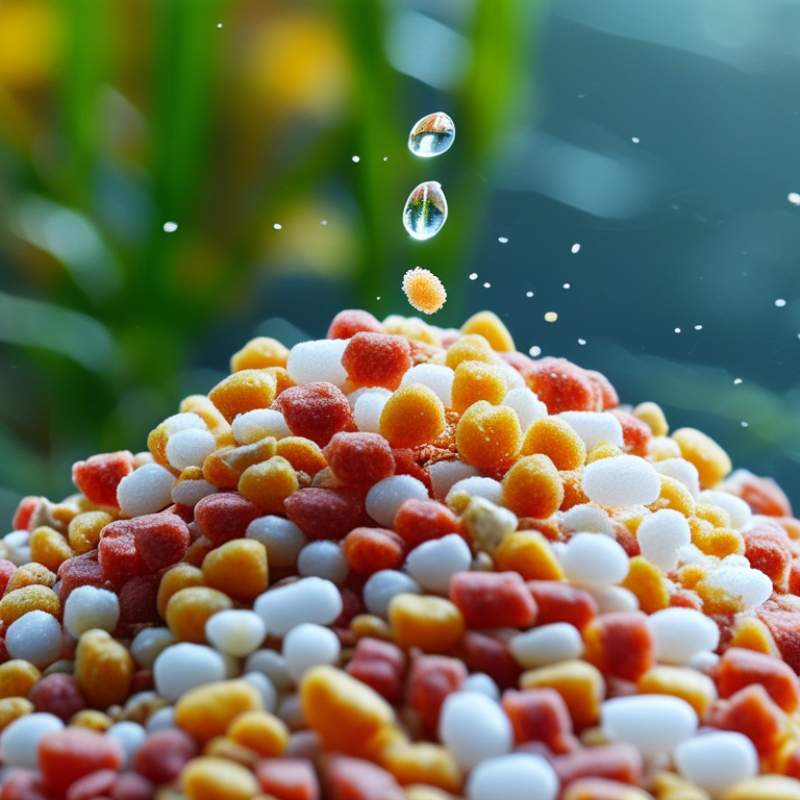
Pellet Structure: How Specialized Binders Support 1–3% Inclusion Rates
Why Use Specialized Binders in Sinking Fish Pellets?
Pellet Structure: How Specialized Binders Support 1–3% Inclusion Rates
Specialized binders help sinking fish pellets keep their shape during mixing, pressing, cooling, and water exposure. At only 1–3% inclusion, they can strengthen the pellet without heavily reducing nutrient density. That small dose matters. A well-selected binder supports compact structure, controlled sinking, and fewer broken particles in the bag.
In practical feed production, pellet quality depends on more than binder percentage. Moisture, starch level, grinding size, steam, and die pressure all affect the final result. Too little binder may produce surface cracks and cloudy water. Too much can create overly hard pellets that fish struggle to soften. A qualified nutritionist should review these interactions rather than change one ingredient blindly.
Simple checks reveal useful details. Drop pellets into water. Watch for cracks, dust, and uneven sinking. Measure water stability at several time points. Record each result with batch moisture and processing temperature. The difficult part is consistency. A formula may perform well one week and weaken after a raw material change. I would not treat 1–3% as a fixed answer. It is a practical range, not a guarantee. Trial work, careful records, and species-specific feeding observations still matter.
Why Use Specialized Binders in Sinking Fish Pellets?
Pellet Structure: How Specialized Binders Support 1–3% Inclusion Rates
Specialized binders are commonly evaluated within a practical inclusion range of 1–3%. Lower inclusion levels can support cohesion, while higher levels may provide additional resistance to crumbling and water breakdown. The optimal rate depends on ingredient composition, pellet size, conditioning, and extrusion or pelleting conditions.
Water Stability: Why Binders Help Sinking Pellets Withstand 30–60 Minutes
Why Use Specialized Binders in Sinking Fish Pellets?
A sinking pellet must reach the feeding zone without breaking apart. Specialized binders help hold starch, proteins, oils, and micronutrients together during immersion. This matters because fish may feed for 30–60 minutes, especially in deeper ponds or cages. Weak pellets can cloud the water quickly. Nutrients then drift away before fish consume them.
The FAO’s 2024 State of World Fisheries and Aquaculture reported 130.9 million tonnes of global aquatic animal production in 2022. As aquaculture expands, reducing feed waste becomes increasingly important. The National Research Council’s Nutrient Requirements of Fish and Shrimp also links feed processing with nutrient availability and feeding performance. A suitable binder supports pellet integrity while limiting excessive nutrient leaching.
Thirty minutes is not a magic number. Water temperature, salinity, pellet diameter, starch gelatinization, and binder dosage all change stability. A dense pellet may sink well but still soften too quickly. An overbound pellet may remain intact, yet reduce digestibility or feeding response. That trade-off deserves testing.
Practical evaluation should include immersion tests at 15, 30, and 60 minutes. Measure pellet mass loss, water turbidity, and remaining shape. Check them by hand. Laboratory results can look excellent, while pond conditions expose cracks, oil separation, or poor acceptance. Binder selection should therefore follow species behavior, processing conditions, and actual farm observations, not only a specification sheet.
Sinking Performance: Linking Binder Choice to 3–6 m/min Descent Rates
Why Use Specialized Binders in Sinking Fish Pellets?
A sinking pellet is not simply a dense pellet. Its descent rate depends on density, porosity, diameter, and water resistance. For many farmed fish, 3–6 m/min offers a practical feeding window. The pellet reaches the feeding zone without disappearing too quickly. Specialized binders help control this movement.
Gelatinized starch can improve cohesion and reduce surface cracking. Hydrocolloid binders may strengthen pellets while limiting water penetration. However, too much binder can increase density and slow nutrient release.
The target is useful, but not universal. Water temperature, salinity, current, and fish behavior can change sinking performance. The FAO State of World Fisheries and Aquaculture 2024 reported 130.9 million tonnes of aquatic animals produced in 2022. This scale increases the value of repeatable feed testing. The NRC publication Nutrient Requirements of Fish and Shrimp also stresses feed stability and nutrient availability in water. Both factors should guide binder selection, not pellet appearance alone.
In practice, manufacturers should measure descent rates in a clear water column.
Test at least three batches. Record pellet diameter, temperature, and immersion time. A binder may produce a clean 4 m/min result in still water, yet fail in a pond with aeration. That gap deserves attention. We often treat 3–6 m/min as a fixed answer, although it is better viewed as a starting range for species-specific trials.
Nutrient Retention: How Binders Reduce Leaching During Extended Immersion
Why Use Specialized Binders in Sinking Fish Pellets?
Sinking pellets may remain underwater for several minutes before consumption. During this period, soluble amino acids, vitamins, and minerals can escape into the water. The National Research Council’s Nutrient Requirements of Fish and Shrimp (2011) warns that water exposure can reduce the availability of sensitive nutrients. This matters. Lost nutrients cannot support growth.
Specialized binders improve pellet cohesion and slow water penetration. Gelatinized starch, alginate, and selected protein-based binders can create a tighter internal structure. In practical feed testing, producers often measure water stability after 15, 30, and 60 minutes. A well-bound pellet should retain its shape, resist surface cracking, and limit cloudy water. The FAO State of World Fisheries and Aquaculture 2024 reported that aquaculture produced 51% of global aquatic animal production in 2022. At this scale, small nutrient losses can become expensive and environmentally significant.
Binder selection still requires caution. Too little binder causes rapid disintegration. Too much may reduce digestibility or weaken sinking performance. Our own tank trials can also mislead, especially with unusually calm water. Feed should be tested under realistic depth, temperature, salinity, and feeding conditions. A 60-minute stability result sounds impressive, but fish may feed within five minutes. The useful question is simpler: does the pellet preserve nutrients until the target species consumes it?
Why Use Specialized Binders in Sinking Fish Pellets? - Nutrient Retention: How Binders Reduce Leaching During Extended Immersion
Representative performance comparison under controlled water-immersion conditions
| Binder Type |
Primary Binding Mechanism |
Typical Inclusion Level
(% of diet) |
Expected Water Stability
After 60 Minutes |
Typical Dry-Matter Loss
After 60 Minutes |
Nutrient Retention Benefit |
Best-Fit Application |
| Sodium Alginate |
Forms a water-resistant gel, especially when calcium ions are available. |
0.5–2.0% |
High
Pellets generally maintain shape with limited surface erosion. |
5–12% |
Strong reduction in the release of soluble protein, amino acids, and water-soluble vitamins. |
Slow-sinking pellets and feeds exposed to long immersion periods. |
| Gelatin |
Protein-based film formation and thermally induced gelation during processing and cooling. |
1.0–4.0% |
Moderate to high
Produces cohesive pellets when adequately hydrated and processed. |
8–18% |
Improves particle integrity and helps retain protein-rich fines and dissolved nutrients. |
Feeds requiring good cohesion, moderate water stability, and a protein-based binder. |
| Carboxymethyl Cellulose |
Increases viscosity and creates a hydrated polymer network around feed particles. |
0.5–2.0% |
Moderate to high
Reduces crumbling and slows water penetration. |
8–20% |
Helps limit leaching of soluble carbohydrates, minerals, and low-molecular-weight nutrients. |
Compact sinking pellets where surface durability and controlled hydration are important. |
| Wheat Gluten |
Develops a continuous viscoelastic protein matrix during mixing and heating. |
2.0–6.0% |
Moderate
Provides strong cohesion, although stability depends on formulation and cooking. |
12–25% |
Retains protein and fine particles by strengthening the internal pellet matrix. |
Protein-rich sinking diets and formulations requiring improved mechanical strength. |
| Modified Starch |
Gelatinization and retrogradation create a cohesive starch structure after cooking. |
2.0–8.0% |
Moderate to high
Performance improves substantially with sufficient heat and moisture. |
8–20% |
Reduces the escape of soluble nutrients and supports retention of oils within the pellet matrix. |
Extruded or steam-conditioned feeds with controlled processing conditions. |
| Lignosulfonate |
Promotes particle adhesion and improves pellet hardness through surface and internal bonding. |
0.5–3.0% |
Moderate
Improves handling durability and slows disintegration in water. |
12–28% |
Primarily protects physical structure, indirectly reducing nutrient loss from broken particles. |
Durable sinking pellets where mechanical strength and reduced fines are priorities. |
| Binder Blend |
Combines gel formation, viscosity control, protein networking, and starch adhesion. |
1.0–4.0% |
High
Can provide balanced stability across different water temperatures and hardness levels. |
5–15% |
Often offers the broadest protection against leaching of protein, minerals, vitamins, and soluble energy sources. |
Extended-immersion feeds and formulations containing high levels of soluble ingredients. |
Interpretation: Lower dry-matter loss indicates better retention during immersion. The ranges shown are representative formulation benchmarks rather than universal specifications. Actual results vary with pellet diameter, milling size, extrusion or pelleting conditions, water temperature, salinity, hardness, agitation, and the solubility of the nutrients used. A practical comparison should use the same pellet size and composition, with measurements taken at 15, 30, 60, and 120 minutes of immersion.
Binder Selection: Comparing Alginate, Gelatin, Starch, and Bentonite Functions
Why Use Specialized Binders in Sinking Fish Pellets?
Binder choice affects pellet strength, sinking speed, water stability, and nutrient retention. In practical formulation trials, alginate performs well when a firm gel is needed. Calcium-assisted setting can create a compact structure. It may also slow nutrient release in water. However, excessive alginate can make pellets rubbery and difficult to digest.
Gelatin provides strong cohesion and a smooth texture. It works well in cold processing and can reduce powder loss during handling. Warm water may weaken its structure, though. Starch behaves differently. Heat and moisture gelatinize the granules, helping ingredients hold together during pelleting. Proper starch levels can improve durability, but too much may increase expansion and alter sinking behavior. Small process changes matter.
Bentonite mainly contributes water absorption, density, and structural firmness.
It can help pellets sink steadily, especially when the formula contains light plant ingredients. Yet high inclusion may dilute nutrients, reduce palatability, or interfere with digestion.
A harder pellet is not automatically better. I once assumed maximum water stability was ideal, but excessive firmness can limit feeding efficiency. Each binder should be tested with the target species, water temperature, pellet size, and cooking conditions. Measure sinking time, surface breakdown, nutrient leaching, and acceptance after soaking. Formulation decisions should follow those observations, not appearance alone.
Conclusion
Specialized binders play an important role in producing sinking fish pellets that remain intact, nutritionally effective, and easy to manage in water. At inclusion rates of around 1–3%, they improve pellet structure by helping ingredients adhere during processing and reducing crumbling. This is especially valuable when pellets must remain stable for 30–60 minutes, allowing fish sufficient time to consume them while limiting the release of nutrients into the surrounding water. The question “why do fish farmers use specialized binders in sinking pellets” can be answered through their combined benefits in durability, feeding efficiency, and water quality management.
Binder selection also affects sinking performance. A suitable formulation can help pellets descend consistently at approximately 3–6 m/min, matching the feeding behavior of many aquatic species. Alginate may form a cohesive gel, gelatin can improve binding and texture, starch supports expansion control and structural strength, while bentonite can contribute to firmness and density. Choosing among these options depends on pellet ingredients, target sinking speed, required water stability, and the need to reduce nutrient leaching during extended immersion.
 Akston Health
